Established in 1962, the Common Agricultural Policy (CAP) is the European Union’s (EU) central agricultural and food policy. The CAP offers direct monetary support to farmers and supports rural development through funding plans. Its goals have significantly changed over the past few decades. It is widely acknowledged that the CAP is one of the EU’s most integrated policies. The CAP’s decisions are created at the EU level and implemented nationally through each Member State. However, the CAP has been very controversial and has received much criticism from around the world.
Goals of the CAP
Created in the post-war era, the original Common Agricultural Policy sought to ensure food security in Europe (which was struggling with food shortages) through policies that enhanced productivity in the production line. The Treaty on the Functioning of the European Union outlines the policy’s main intentions:
- Boost agricultural productive by modernizing infrastructure and promoting technological innovation.
- Support fair standards of living by establishing safeguards of farmers’ incomes.
- Establish stable markets through management of agricultural supply and demand to prevent unstable prices.
- Maintain a stable and affordable supply of food for consumers.
- Promote rural economies by supporting jobs in farming and the agricultural industry as a whole.
In recent years, environmental targets have been added to these intentions.
The CAP consists of two pillars.
Pillar I takes up the majority of the CAP budget. It works towards supporting the economic well-being of farmers and agricultural producers.
- Direct payments. Farmers are provided payments that are scaled to the amount of land that they use. However, for farmers to receive payment, they must carefully follow environment and animal welfare requirements.
- Eco-schemes. Farmers are rewarded for sustainable and responsible practices through voluntary environmental programs that were introduced in the 2023-2027 reform.
- Market measures. Public intervention and storage aid are used to support the agricultural market during times of uncertainty, such as oversupply or decreased demand.
Pillar II supports both national and regional programs that work towards the development of rural areas. It focuses on economic, social, and environmental stability, using policies such as infrastructure investments, biodiversity regulations, and direct financial support.
Continuous reform of the CAP
- Surpluses of the 1960s–1980s. At first, the CAP put a large emphasis on price support. However, the price support would lead to consequential overproduction, leaving excess food in piles around the continent. This would result in high costs and criticism from around the world.
- The MacSharry reform of 1992. The reform market a major change in policy implementation, shifting away from price support. Instead, the CAP focused on directly supporting the income of farmers, especially those in rural area. Payments were no longer connected to the amount of food produced.
- Less emphasis on production in 2003. Again, the CAP was reformed to further separate payments from amount of food produced. Instead, payments began to rely on the following of environmental and animal welfare requirements.
- Focus on greening from 2014-2020. The period of reform would initiate greening measures. The greening measures build upon the reforms in 2003, connecting directly payments to farmers who practiced sustainable methods of farming.
- Increased flexibility from 2023-2027. The modern iteration of the CAP has been designed to provide Member States of the EU increased flexibility when designing national plans. The plans can now be designed to meet local needs while simultaneously working towards EU goals of social, economic, and environmental sustainability.
Pros and cons of the CAP
Pros
- The CAP has worked to make sure that there is always a stable supply of affordable food for EU citizens.
- The CAP has helped to support rural communities and promote the job security of local farmers.
- The CAP has adapted to place demands of sustainable agriculture and environmental protection amongst Member States.
Cons
- Many critics have argued that those who benefit the most from the CAP are the large landowners, with the rural farmers having been left in the dust.
- While the CAP has worked towards sustainability and environmental protection, many argue that the current funding processes are not able to seriously support ambitious climate and biodiversity goals.
- The policies of the CAP, such as export subsidies and high import tariffs, have directly hurt localized farmers in developing countries. There have been recent efforts to reduce this negative side-effects of the CAP but there are still many concerns regarding its worldwide consequences.
The CAP’s future.
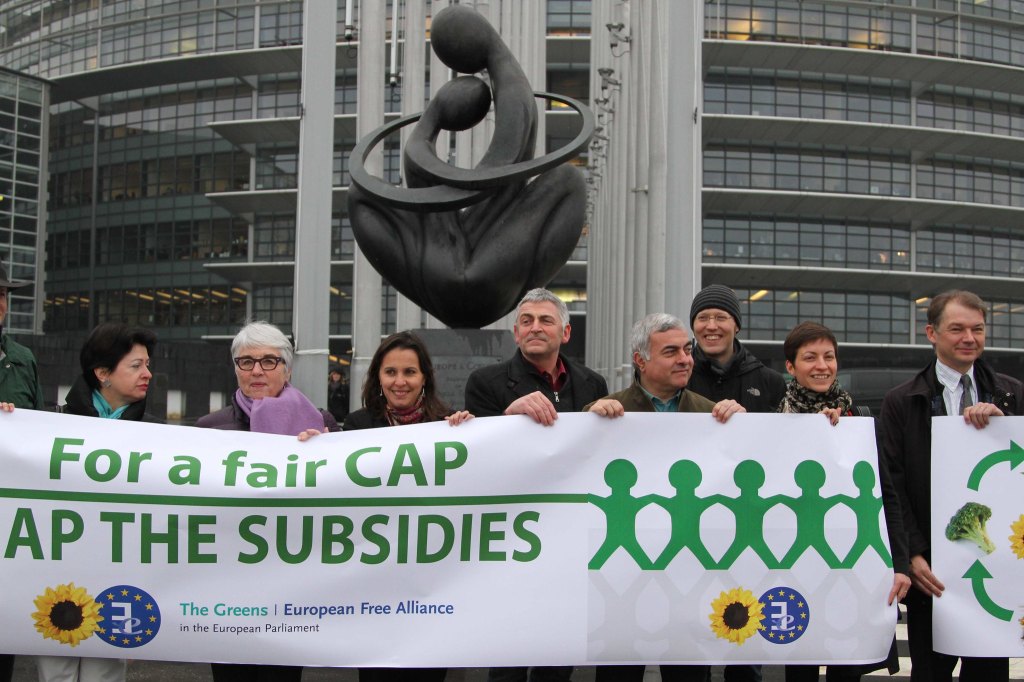
The CAP has undergone major reforms in the past, and it will undoubtedly undergo major reforms in the coming years. Recently, there has been significant debate on what the future of the policy may entail. Proposals have pushed for increased simplicity in its regulations, more autonomy for Member States, and improved environmental and sustainability efforts. However, there has been consistent disagreement, with farmer protests and tensions between policymakers increasing since 2020. For the CAP to work towards it goals of environmental welfare, market stability, and success for farmers, EU policymakers must invite discussion from all parties involved, working towards new reforms as a unified effort.
WORKS CITED:
https://academic.oup.com/book/34416/chapter-abstract/291982265?redirectedFrom=fulltext
https://agriculture.ec.europa.eu/common-agricultural-policy/cap-overview/cap-glance_en