From the second I landed at Jomo Kenyatta International Airport last July, I could sense a lingering tension. Security guards suspiciously stared down each passenger, roads were blocked off outside of the airport, heavy security checkpoints were set up around the capital city.
Ibrahim, our taxi driver, immediately explained the situation as he drove us to our hotel.
On July 7, 1990, thousands of Kenyans poured out onto the Kamukunji grounds of Nairobi to demand free, multiparty elections. These demands conflicted with the oppressive one-party system that president Daniel Arap Moi controlled at the time. These protests were met violently by the police and security. Hundreds were injured, arrested, and killed. However, the protests managed to garner support for the new cause and eventually helped to force the repeal of Section 2A of the constitution in 1991. This repeal allowed for a new, multiparty political system which promoted greater political freedoms throughout Kenya. These protests, occurring on 7/7/1990, would be known as the Saba Saba protests. “Saba Saba” means “seven seven” in Swahili. Since the protests of 1990, July 7th has been celebrated as Saba Saba Day in Kenya. On Saba Saba Day, Kenyans are urged to reflect on their political freedoms and push for even greater social justice.
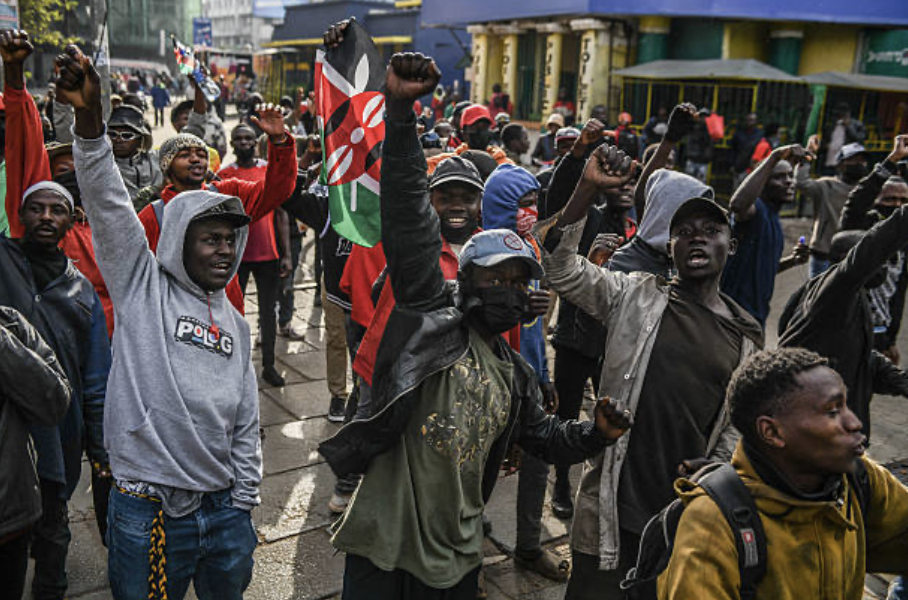
In 2025, Saba Saba Day was met with a driven, angry crowd of young Kenyans. Their anger was sparked by economic grievances and perceived government corruption. The protesters were particularly angered by the Kenya Finance Bill 2024, which was widely viewed as unfair due to the introduction of new taxes and fines that hurt the average Kenyan. As a result, a large number of economically disadvantaged and young Kenyans took to the streets. The protests would quickly evolve, shifting from economic grievances to broader, systematic demands. Suddenly, protestors spoke out against the government, angered by apparent corruption, systematic violence, and a lack of opportunity to succeed. They also acknowledged police brutality and state-sponsored executions without proper trials.
As the mob of protesters quickly grew on July 7, 2025, government forces responded, blocking off major roads, barricading buildings, and sending out large groups of police. Their response to the protestors was brutal, almost mirroring the violent protests 35 years prior. The police used tear gas, live ammunition, and water cannons on the protestors. Dozens of protestors were killed, with many more wounded and arrested. It has even been reported that the police collaborated with unofficial gangs to attack the protestors, violating human rights codes. The right to peaceful protest, guaranteed by the Kenyan constitution, was violated by the government who suppressed those who spoke out against the state.
As Ibrahim drove us through Nairobi, the later stages of the protests were still in full flow. Ibrahim explained that we had to take new routes to avoid the protestors and the state-induced violence. Ibrahim continued, proclaiming that he was concerned about Kenya’s future, and questioned whether he should seek a new life abroad.
The protests of 2025 reveal that everything is at stake in Kenya right now. Decades after the original protests, many of the same issues and institutional flaws are still present in the country.
In fact, many feel an even greater sense that political institutions can no longer support the well-being of the common people. If protests are met with extreme violence, one can only wonder if the country will eventually fall to an authoritarian regime. Freedom of expression is a fundamental component of a functioning democracy. Removing the ability to speak freely undermines democratic institutions and fuels a sense of mistrust.
However, the protests can also be seen as a positive sign for what is to come. The new, younger generations are clearly fighting for a responsible democracy, and are willing to hold their leaders accountable and stand up for their constitutional rights.
WORKS CITED:
https://www.bbc.com/news/articles/c78n397gzjpo
https://www.dw.com/en/kenya-tensions-after-more-deadly-protests/a-73198880