
Improving the performance of agriculture is critical in promoting development throughout Africa. To dive into the complex and constantly evolving state of agriculture in Africa, I interviewed Dr. Simeon Ehui. Dr. Ehui is a renowned global expert in agriculture. He is currently the Director General of the International Institute of Tropical Agriculture (IITA), and Regional Director for Africa for the Consultative Group for International Agricultural Research (CGIAR). In my interview, Dr. Ehui exposed a much broader reflection on African agriculture and reminded me that agriculture is “science, problem-solving, and smart decision-making.”
In our interview, I was instantly struck by the sheer clarity of Dr. Ehui’s vision. He explained that research must contribute to a real, measurable impact, and that innovation must serve local communities to build a brighter future for Africa. This future must be built through collaboration and the contribution of different groups. Specifically, our interview focused on how African agriculture will be transformed in the future to combat both food insecurity and climate change.
The role of research and innovation
Dr. Ehui started off by explaining that “Agriculture is more than farming. It is science, innovation, and hope for the future, especially for Africa.” Today, farmers are faced with extreme challenges, such as climate shifts, degraded natural resources, increased soil erosion, and influx of pests and disease. To combat these challenges, Dr. Ehui argued that research and innovation cannot be optional. They are essential in building a modern agricultural system. He explained that “Research allows us to understand these problems, while innovation helps us turn knowledge into practical solutions such as better seeds, smarter farming practices, and improved storage and processing methods.” Without consistent investment into research, agriculture would not be able to feed growing populations or create new opportunities for the youth. It is this context in which IITA and other centers under CGIAR come into the equation. As the world’s largest global agricultural research and innovation network, CGIAR completes “research with partner organizations based on what farmers need and develop innovations that help produce more food, provide jobs and livelihood opportunities, and conserve our environment.”
Innovations are making a difference
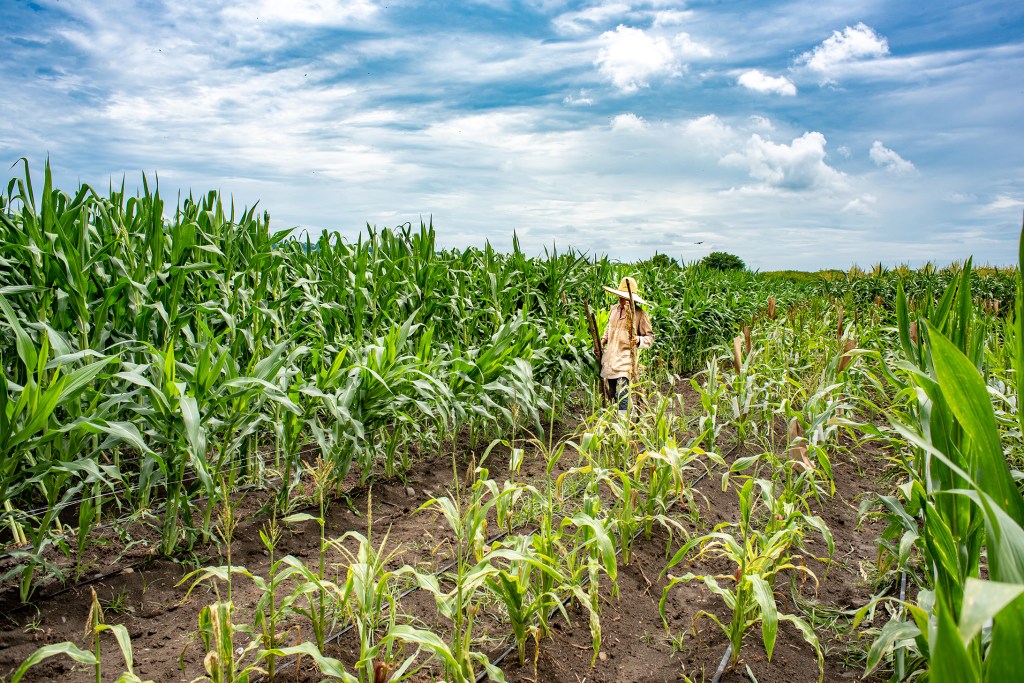
Looking into the future, Dr. Ehui pointed to a number of innovations and developments that can shape the future of African agriculture, many of which are supported by CGIAR centers. Perhaps the most influential of these innovations is the climate-resilient crop. Dr. Ehui explained that these climate-resilient crops can “survive drought, heat, floods, and diseases.” In fact, “climate-resilient maize developed by CGIAR centers are grown in 13 African countries and deliver 30% more yield, with 2.1 million people lifted out of poverty.”
Another important innovation is digital agriculture, where mobile phones are used “to provide farmers with weather information, market prices, and farming advice.” Digital agronomic services such as “Akilimo” help farmers improve their fertilizer and soil practices through recommendations, which help to “restore soil health and increase productivity.”
He also underscored the importance of affordable mechanization, which “reduces hard labor and attracts young people to farming.” In addition to affordable mechanization, better storage and processing technologies help “to reduce food loss after harvest.” Dr. Ehui exclaimed that “These innovations, if adopted in the near term, can help Africa produce more food sustainably while creating jobs and protecting the environment.”
Barriers to adoption of innovations in Africa
However, Dr. Ehui recognizes that there are many barriers that prevent widespread adoption of these innovations. Some of these challenges include “limited access to finance, weak infrastructure, and poor distribution systems. In some cases, farmers are not aware of new technologies, or they cannot afford them. Policies and regulations can also slow down the spread of innovation.” To combat these barriers, he emphasized the solutions must be “affordable, trusted, and adapted to local conditions.”
Collaborations to support research and innovation
Our interview quickly shifted to the relationship that CGIAR has with universities across Africa. CGIAR has adopted a collaborative approach, stressing research in partnership with local universities. This research starts off with real problems that local farmers are facing, and it evolves through large partnerships with nearby universities. These partnerships allow scientists and researchers to work in laboratories, on the field, and also with farmers. They allow for the training of the “next generation of African scientists while producing innovations that improve food systems and livelihoods.” This collaboration helps scientists and graduate students work together, sharing facilities and publishing scientific findings. In fact, Dr. Ehui explained that “In IITA, we have trained more than 140,000 national researchers across Africa who now occupy important positions that can influence agricultural transformation in the continent.” These researchers have helped ensure that innovation and local success are connected, from crop disease detection to improved crop variety around the continent.
Throughout the interview, Dr. Ehui repeatedly underscored the importance in ensuring that research is used to directly improve lives. To accomplish this, local farmers are invited to help test new technologies, and successful innovations are spread through government partnerships and extension services. A great example of this is the Technologies for African Agricultural Transformation (TAAT) program. Dr. Ehui explained that “the IITA-led TAAT delivered climate-smart seeds to 12 million farmers in 27 countries in 3 years. Research has real value only when it improves incomes, nutrition, and resilience.”
Dr. Ehui continued by explaining the importance of collaboration between the private and public sectors: “The private sector plays a key role in scaling innovations. Companies help produce seeds, machinery, digital tools, and food products at scale. Successful partnerships depend on trust, shared goals, quality standards, and strong local networks. When research institutions and businesses work together responsibly, farmers benefit the most.” A great example of this is Aflasafe. Dr. Ehui told me that “IITA scientists developed Aflasafe as a biological control to reduce aflatoxin contamination in staple crops like maize and ground nuts. But without the private sector, it would likely have remained a successful experiment, not a scalable solution.” Through collaboration, the private sector allows laboratory innovations to be scaled and transformed into large-scale health and food security solutions throughout Africa.
Dr. Ehui highlighted that research also means learning when things don’t succeed. Technologies that are “too expensive, too complex, or poorly adapted to local needs rarely succeed. We have learned that scaling must be planned early, with strong delivery systems and farmer involvement.”
A message for the future
Dr. Ehui is very optimistic for the future of African agriculture. A large source of this optimism comes from the creative, energetic, and collaborative African youth. He exclaimed that the next generation of Africans “are the future of African agriculture.” He is especially excited by the progress that young farmers, especially women, are making in the journey towards a sustainable food system.
To close out the interview, I asked Dr. Ehui for advice for the young students interested in the field of agriculture. His answer was simple: “stay curious and focus on solving real problems. Agriculture needs scientists, engineers, data analysts, communicators, and entrepreneurs. Learn as much as you can, embrace technology, and care for the environment.”






Leave a comment