
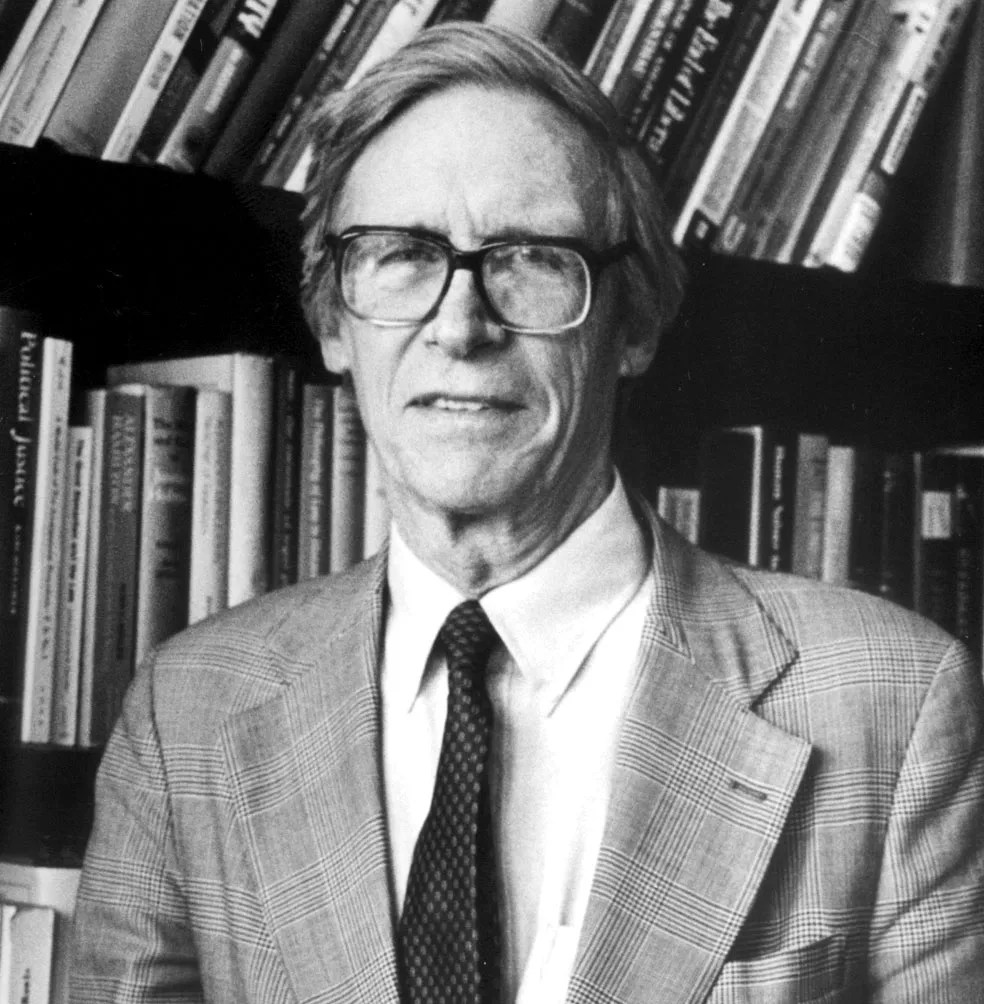
John Rawls, born on February 21, 1921, was one of the most influential political and ethical philosophers of the 20th century. Rawls is acclaimed for his work on liberal egalitarianism, which is a political philosophy that combines the protection of individual liberties, while maintaining a commitment to social and economic equality. Rawls was also prominent in the revival of the “social contract” and grew the argument that justice must be rooted in fairness, not total equality.
One of Rawls’ most influential pieces of writing was A Theory of Justice, published in 1971. In the book, Rawls provides a detailed perspective as to which principles should govern a just society, transforming modern political philosophy. Instead of continuing to promote tradition, economic prosperity, and religion, Rawls turns to a single idea: justice should be based on fairness. This theory, often titled “justice as fairness,” has heavily influenced our current approach to rights and opportunity.
Rawls starts to build his argument by introducing an important claim. He asserts that in a just society, basic institutions must be established in a fair manner. These institutions, such as the legal system, the economy, the political process, and education, influence people’s life chances. Because of their profound influence on society, their structure must be fair and just to all.
Many other utilitarian philosophers argue that society should aim to maximize overall happiness, even if it comes at the expense of a few individuals. Rawls, however, holds a more nuanced view. Rawls insists that each person possesses an inviolability that cannot be sacrificed for the greater good. Justice should not be characterized as maximizing total happiness and prosperity. Rather, it is about protecting every individual and securing fairness.
The Veil of Ignorance
To further develop his argument, Rawls introduces an intriguing thought experiment to illuminate what fairness truly requires. Rawls asks us to imagine a group of rational individuals who are tasked with the job of creating the principles in which their society will be governed. However, these decisions must be created behind the “veil of ignorance.” Behind the veil, none of the individuals know their own race, wealth, gender, religion, etc. They don’t know if they are rich or poor, healthy or sick. Because they don’t have this information, they are forced to create principles that are fair to all possible positions in society that they may be part of. This experiment removes bias and self-interest from the decision making process. If you had the possibility of ending up poor, you would not design a system that provides no help to the less-fortunate. If you might end up in a minority group, you would not design a system in which discrimination is accepted. The “veil of ignorance” forces rational individuals to think impartially.
Two Principles
Following his thought experiment, Rawls argues that rational individuals in the original position would inherently agree on two principles.
Equal Basic Liberties
The first principle Rawls highlights is basic liberties. This principle states that each person has an equal right to fundamental basic liberties. These liberties include freedom of religion, freedom of speech, the right to vote, and the right to assemble. Rawls explains that this principle takes priority. Basic freedoms cannot and should not be left behind for economic gain. No society can justify limiting freedoms, even if doing so would increase overall prosperity.
Social and Economic Inequality
The second principle that Rawls introduces states that social and economic inequalities are acceptable under two conditions.
- They are connected to a system in which everyone is under the condition of fair equality of opportunity.
- They benefit the least advantaged members of society (the Difference Principle)
This Difference Principle is perhaps Rawls’ most controversial proposal. It states that inequality is permissible only if it improves the situation of society’s least fortunate. Here’s an example: Higher salaries for doctors and health professionals can be justified if they incentivize medical innovation and greater care which benefits everyone, including the poor. On the other hand, inequality that only enriches the wealthy and doesn’t help the least advantaged would not be just.
Equality of Opportunity
Next, Rawls explains the difference between formal equality and fair equality of opportunity. Formal equality states that positions are open to everyone, while fair equality of opportunity requires much more. Within a fair equality of opportunity, individuals with similar talent and skills should have the same chances of success, regardless of their personal background. This explains why a just society must aim to tackle structural disadvantages. Access to healthcare, education, and social support become essential in maintaining justice.
Applications Today
Rawls’ A Theory of Justice has influenced current debates about taxation, welfare states, healthcare, and education policy. His arguments provide a moral argument for redistributive policies that are created to help the least advantaged within society.
Today, Rawls’ “veil of ignorance” can be applied to discussions about systemic racism, income inequality, and equal access to opportunity. It demands that we vacate our current position in society, and asks us to determine which rules we would choose if we didn’t know which part of society we would fall into.
Rawls has also heavily influenced human rights theories and even constitutional designs. His emphasis on equal basic liberties, democratic governance, and the protection of minority rights has been adopted by governments around the world.
Many critics, however, have heavily criticized aspects of Rawls’ theory. For example, some argue that Rawls has portrayed individuals as detached from their social identities. Individuals, they argue, are shaped by communities and shared values, which Rawls seems to overlook.
Despite the criticism, Rawls has left a large contribution to the field of political philosophy. He was able to reform discussions of justice around fairness and equality. He challenges us to ensure that social cooperation is structured in a way in which every person can accept. Decades following its original publication, A Theory of Justice still serves as a foundation of modern political thought, and forces us to consider what a just society truly looks like.
WORKS CITED
https://www.britannica.com/biography/John-Rawls







Leave a comment